GO TO
RELATED
OUR PRACTICE AREAS
Navigating Your Farm’s Future: A Guide to Rural Succession Planning
Embarking on a farm succession journey requires careful planning. Whether you’re a seasoned farmer considering retirement or the next generation eager to carry on the family legacy, implementing a robust succession plan is essential.
At CLO Lawyers, our expert Toowoomba Wills & Estate lawyers understand farming families' unique challenges in navigating succession planning. Don’t wait. Start planning today.
The Key to Success – Start Early and Plan Wisely
Gone are the traditional inheritance norms; fairness among family members is now the focus. The key lies in understanding that fair doesn’t always mean equal. And that’s the unique challenge for families in rural succession planning.
Successful rural succession planning hinges on starting early. Waiting for significant life events such as retirement, a family member’s return to the farm, marriage, divorce, or death can limit the available options.
For the older generation, setting clear goals involves contemplating retirement plans, management handover timelines, and future living arrangements.
Considerations for the next generation include personal aspirations, working relationships with siblings, fair compensation, and the farm’s financial capacity.
Early planning, clear objectives, professional advice, and open communication are critical to success in rural succession planning.

A smooth transition from one generation to the next will safeguard the family’s farming legacy. At CLO Lawyers, we are experienced in supporting farming families navigating the complexities of succession planning. We will guide you every step of the way.

Rural Succession Planning: Navigating Complexity
Rural or farm succession planning goes by many names – family succession planning, farm inheritance, rural inter-generational transfers, family future planning, or agribusiness succession planning.
It forms part of an overall business plan. The plan is a living and dynamic roadmap that adapts to changing circumstances, preserving a family’s farming legacy into the future.
There are 3 fundamental principles underlying the process of succession planning:
- The necessity to plan.
- The importance of obtaining expert guidance.
- The desirability of keeping the family and the business intact.
Succession planning can uncover challenging and complex issues for families, given the nature of the enterprise and family dynamics. However, failure to address these issues will likely result in conflict, confusion, and uncertainty.
While success cannot be assured, understanding the following principles will improve the prospects of achieving the desired outcomes:
- Each farming business solution is unique.
- Professional advice from your business accountant, an experienced succession lawyer, and a good agri-business consultant is essential.
- Open communication with family members and professionals is crucial.
- Differences in generational values within the family must be recognised and accommodated.
When choosing professional advisors, different approaches and personalities will suit each situation. Recommendations from those who have undergone the process can be valuable.
CLO Lawyers boasts a team of Toowoomba Wills and Estates lawyers experienced in aiding farming families in negotiating the complexities and challenges of developing a farming business solution.
What Happens to the Farm?
Deciding what happens to your rural enterprise when you retire might be confronting. However, taking on the challenges of succession planning is vital for ensuring the business survives into the next generation.
Most families have moved beyond the tradition of leaving the land to the eldest son. This evolution has made succession planning more complicated than in earlier times.
Understandably, families strive for a “fair” arrangement. Ideally, each member of the next generation would receive an equal share of the farm business and estate. However, equality isn’t always fair.
To achieve the best outcome for all concerned, the following should be addressed:
- Understanding the preferences of the retiring generation, including their desires for continued involvement in farm management or living on the property.
- Providing a secure and sustainable retirement plan for retiring family members.
- Addressing family dynamics to build, maintain, and if necessary, repair relationships.
- Identifying the needs and aspirations of each generation and managing expectations.
- Dealing with unequal contributions among family members.
- Determining equitable arrangements for both working and non-working members of the family.
- Planning for transfer of management and control of the farm over time.
- Identify how to transfer ownership of the farm.
Getting Started: The Process Unveiled
So, what do you need to do for your farm succession planning?
The earlier that succession planning starts, the more options are available. Waiting for significant life events like retirement, a child returning to the farm, marriage, divorce, or death limits the scope of your succession plan.
Ensure early planning around a profitable business with off-farm investment to provide for the older generation’s retirement and the needs of off-farm siblings.
If all the assets are tied up in the family farm business, it will be difficult to split those assets between the next generation and make provision for retirement income.
Setting Clear Objectives for Succession
The older generation will need to set clear goals for the future and have a current estate plan.
A roadmap to retirement will need to outline intended living arrangements, aspirations for post-retirement activities such as travel, and required financial support with expected debt level (if any).
Identifying what will be allocated to the farming and non-farming children will be necessary.
A timeline will need to be established for when management and ownership of the farm will be handed over.
The younger generation must ask hard questions about their future goals.
They must be clear about whether farming is a genuine career choice, and whether working with their siblings is desirable. It may be necessary to address whether they have been appropriately reimbursed for work done on the farm. They must also be confident that the farm can provide the financial return required for their desired future lifestyle.
The current financial position must be established to ensure options are generated within a realistic business context. This will require identifying what farm and off-farm assets are held and the ownership structures in place.
It will be necessary to obtain an independent valuation of the farming enterprise and a statement of assets and liabilities to support the succession plan and any funding requirements. Accounting and financial advice will assist in evaluating the farm’s net worth and planning for its future operations.
Initiating the succession process involves understanding family members and managing expectations. Facilitated family meetings or a series of meetings can achieve these objectives.
A checklist for family meetings includes:
- Identifying the participants, their roles, and meeting goals.
- Selecting a neutral venue available for extended periods.
- Identifying a facilitator with expertise in fostering open communication.
- Booking the family accountant who understands the business and can balance the needs of the business with the needs of the family members.
- Ensuring the presence of all family members, including off-farm children and in-laws.

Future Planning Strategies for Succession Planning
Once the family members’ goals and expectations are understood, the next step is identifying strategies with the support of appropriate advisors. Implications of taxes such as capital gains tax, stamp duty, and GST may restrict options due to associated costs. Collaboration with experts ensures consideration of all possibilities and implications.
The future planning strategies may include:
- Transferring real estate and assets to family members during the older generation’s lifetime to avoid property being part of their estate after death.
- Ensuring that the most appropriate legal structures are used when transferring ownership and control of assets.
- Implementing inter-family loan arrangements to protect property.
- Reviewing partnership, trust, company, and superannuation arrangements to ensure they align with future plans.
- Considering the sale of certain assets – now or in the future – and maximising their value before sale.
- Exploring trust arrangements such as testamentary trusts, disability trusts, life estates, life permits, and other trust structures.
- Establishing enduring powers of attorney to deal with matters in the event of incapacity before death.
Beyond a Will: Safeguarding Your Family’s Legacy
Rural succession planning is so much more than a Will. It necessitates a carefully crafted farm succession and estate plan to safeguard the future interests of the family members.
The family farming legacy could be jeopardised even with estate planning arrangements in place.
Potential challenges include:
- A contested Will or challenge to the validity of a Will resulting in costly litigation and unanticipated outcomes.
- The bankruptcy of a beneficiary under a Will, resulting in the loss of gifted property to the trustee in bankruptcy.
- Involvement of a family member in a divorce, leading to claims against gifted property by a former partner.
- Dependents of the testator making claims against the estate.
- Unintended consequences of financing arrangements or property dealings not correctly accounted for in a Will.
Case Study: Real Insights into Succession Planning
As an illustration, consider the following case study describing a family’s rural succession planning journey. This example reflects a real-life scenario. It aims to offer insights rather than prescriptive solutions. The Family Agreement reached reflects the wishes and desires of the parties involved, not necessarily the recommendations of the author or experts involved.
Family Background
The family embarked on succession planning due to the parents’ desire to retire and relocate from the farming enterprise conducted across three properties.
The parents operated the farming business under a partnership on farmland owned personally in their names.
The family comprises 3 adult children, all with similar educational backgrounds and having had equal opportunities.
The parents wished to implement a staged succession plan so that their farming and non-farming assets could be passed on to their children over time.
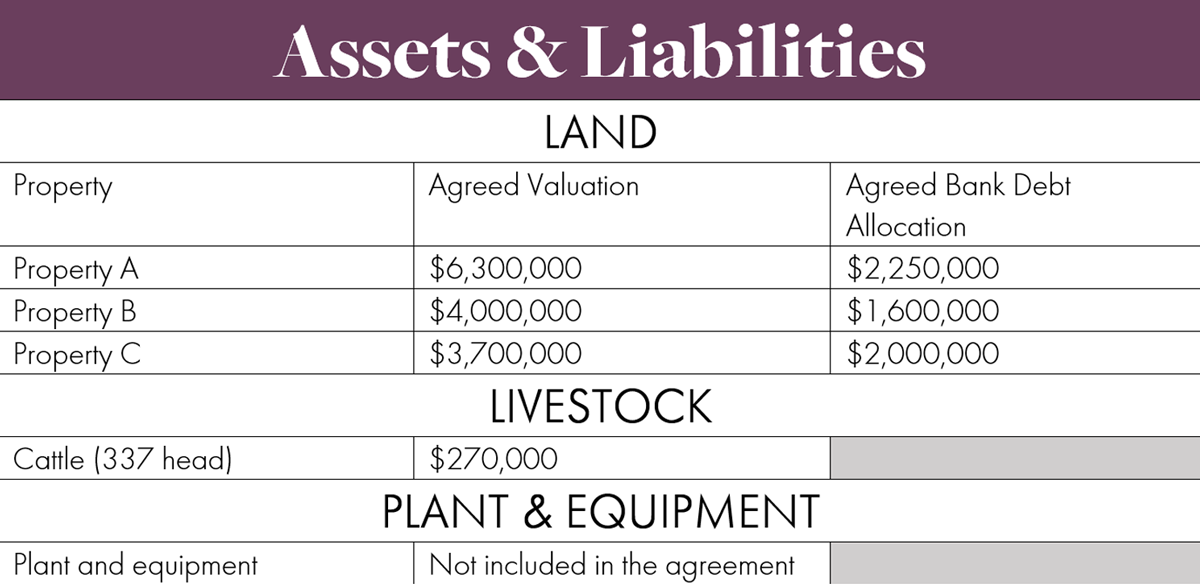
The succession plan comprised agreements recorded in a Family Heads of Agreement and Business Transition and Succession Plan.
These were complemented by Estate Plans, which the parties agreed would be updated with the completion of each stage of the succession plan.
Family Heads of Agreement
1.
Parents agree to sell the farming properties to their children within the time frames specified below:

2.
Purchase prices for each property are based on agreed assessments of value, not necessarily market value.
3.
Farming debt, secured by registered mortgages, is allocated between the properties in accordance with their respective carrying capacities.
4.
Each sale will be documented by a formal Contract of Sale.
5.
Purchase prices will be paid with a cash component sufficient to secure the release of the mortgage secured on the property, with the balance funded by vendor finance arrangement.
6.
Stamp duty liabilities will be borne by the respective buyers.
7.
Parents will sell the cattle to the oldest child at the agreed value through a vendor finance arrangement.
8.
Vendor finance arrangements will be formalised by formal loan agreements containing a first right of refusal provision in favour of family members and secured by a second registered mortgage.
9.
Parents will provide consultancy services to the children for a set annual fee with annual CPI increases, documented in consultancy agreements.
10.
No plant and equipment will be transferred with the property sales.
11.
Children will share equally the cost of any off-farm accommodation (including aged care accommodation) for the parents if required, and any financial assistance provided will be repayable from the parents’ estate with interest.
12.
Parents will update their estate plans utilising testamentary trust wills consistent with the family heads of agreement, appointing each other and the children as their health and financial attorneys, and ensuring that their powers of attorney include authorisation for the attorneys to enter into transactions giving effect to the terms of the family heads of agreement.
13.
The parties will review the terms of the family heads of agreement at least once a year and meet their succession planning intentions.
Conclusion
Establishing a succession plan early eliminates uncertainty, signals the true intentions of all parties, and gives everyone peace of mind. Communication and family consensus are pivotal to preventing unwanted family conflict.
Contact CLO Lawyers Today